
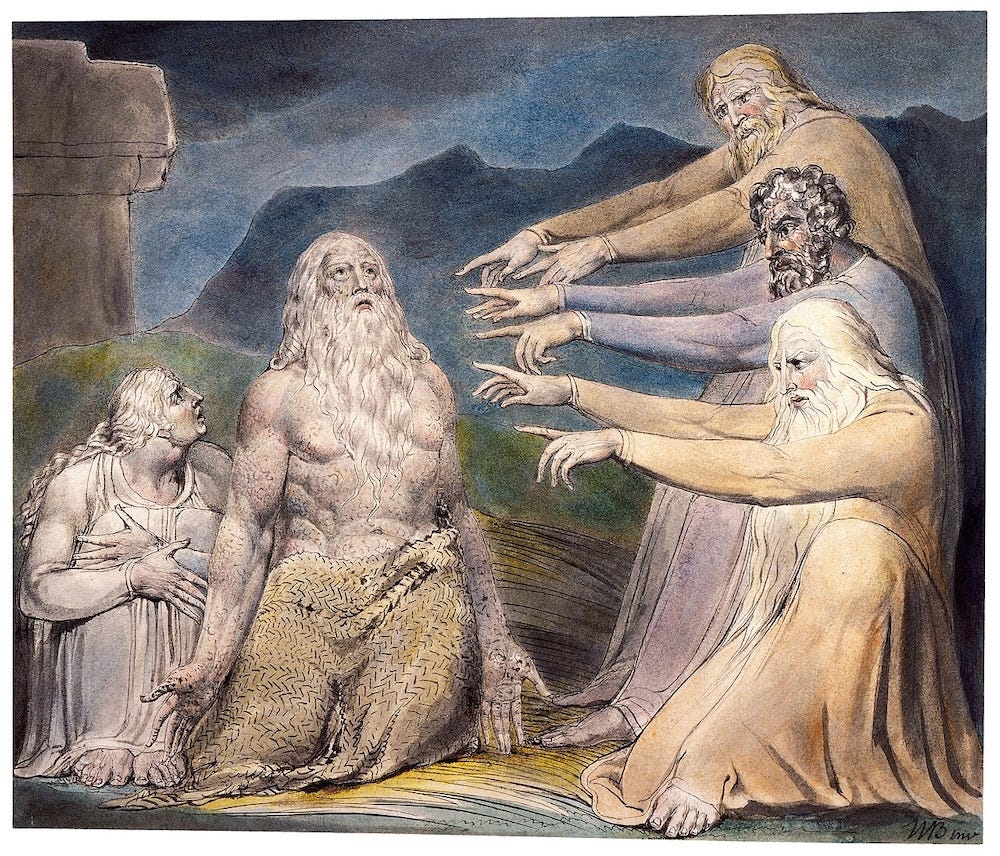
The book of Job is a mystery to many people. Its primary focus, from a human level, is the problem of suffering, yet there’s so much more going on in it beyond the human level.
In reality, it’s a commentary on how God is glorified in our lives, even when we don’t see glory in any direction we look.
It’s also a commentary on superficial spirituality — people who know God’s principles but often can’t recognize his purposes. The world and the church are full of two-dimensional thinking, yet God calls his people to think beyond the dimensions we live in. Jesus didn’t come to give us a set of precepts. He came to give us his presence.
I wrote a brief introduction to the book of Job a number of years ago that I think is worth sharing — not because it explores these themes thoroughly (it’s just an intro) but because it addresses some of the takeaways people think they see in Job that aren’t really there. I hope it will be helpful to some.
Missed Messages
Some people think the message of Job is that God doesn’t put a hedge of protection around His people. But a careful reading of the story reveals that He did have a hedge of protection around Job and removed it temporarily as an exception.
Likewise, some people believe the message of Job is that human suffering is a mystery with no rhyme or reason or acceptable theological explanation, though the first chapter explains clearly why Job suffers. The explanation is hidden to him, even at the end of the story, but the reader sees it plainly.
No, the messages in Job are far more nuanced — and deeper — than most casual readers realize.
In the broadest terms, we can say that human suffering has a purpose, but we often don’t know what it is. In Job’s case, he becomes the subject of the adversary’s bet against God, and God willingly lets one of His choicest servants play that painful role — not because this God is unjust or sadistic, but because there are higher stakes than Job’s immediate welfare. The real theological issue in this book is whether God can be worshiped for His goodness even when His goodness seems to go into hiding. The adversary — literally, the satan — believes Job’s faithfulness is superficially dependent on the blessings he is receiving. God says it’s deeper than that. If this faithful follower of God can continue to worship and follow even when every blessing in his life seems to have been removed, God is glorified and the adversary’s accusations are proven wrong.
And that’s what’s at stake: a statement of God’s glory. Job pays a temporary price for it and will be amply rewarded in the end. But in the meantime, he suffers excruciating pain and rejection and has his faith stretched nearly beyond its limits.
Precepts and Principles without Presence and Purpose
Job’s friends become the theological focal point of this book. They are often criticized for their bad belief system, but few people realize how often they accurately quote biblical principles in their arguments with him. Perhaps that’s why they are so easily and often quoted by believers today; readers see truth in their statements and lift them out of context, not realizing that these babblers are rebuked in the end for everything they say.
But what they say fits well with the blessings and curses of Deuteronomy 28, as well as the proverbs written by wise Solomon later, as well as the dynamics we see throughout the historical books that God blesses those who are obedient to Him and withdraws His blessing from those who aren’t. These are rock-solid biblical truths, Job’s friends quote them, and then they are chastised by God for quoting biblical truth. Why?
Because truth applied at the wrong time in the wrong situation isn’t truth. And Job’s friends are shallow enough never even ask to God what He is doing in the situation. Like many believers today, they have the Word, and they apply it across the board. There’s no need to hear God’s voice if you have a cookie-cutter spirituality, a set of biblical principles to live by. But in the book of Job, that approach is thoroughly rejected.
Truth applied at the wrong time in the wrong situation isn’t truth.
Our relationship with God is a relationship with Him, not with a set of principles, even biblical ones. We have to able to hear His voice and discern His purposes, even when we think we already have a handle on His precepts. Truth that applies in one situation may not apply in another. It depends on the season of a person’s life and what God is doing in it.
Double Restoration
Job is both rebuked and vindicated at the end of His story. He has an encounter with God that brings him to his knees, yet his friends (all but the enigmatic Elihu, who may have expressed and applied God’s truth better than the others) are chastened for their ignorant preaching. And Job’s blessings are restored — doubly so. He receives back exactly twice what he lost. (He only receives an equal number of children, but this is perhaps a subtle hint that his deceased children still live in the afterlife, so an equal number of children doubles the total.)
This is a picture of Paul’s later statement that the cost of our temporary trials will never outweigh the benefits of eternal glory.1 Whatever hardships we go through now, they will fade in comparison to the blessings we receive at the end of them — even if we don’t understand why we’re going through them. There’s a divine drama behind them, and God will be glorified.
And looking back one day, we will be glad for the part we played in that drama — and doubly blessed for it.
Excerpted and adapted from 90 Days Thru the Bible: A Devotional Journey for Walk Thru the Bible (Carol Stream, IL: Tyndale, 2012), 65-67.
2 Corinthians 4:17.